

Project: Resilient Care: Strengthening Inclusive Access to Healthcare in Southern Ukraine

About the project
Throughout the implementation period, NGO CASERS continued to ensure uninterrupted access to healthcare for residents of de-occupied and frontline communities in the Kherson and Mykolaiv regions.
During this period, the security situation in southern Ukraine deteriorated significantly. Constant FPV drone attacks, guided aerial bomb (KAB) strikes, and repeated attacks on civilian infrastructure and transport routes further limited access to healthcare. For many residents, travelling to the nearest hospital became impossible.
In response to these challenges, the project focused on ensuring the sustainability of the healthcare services established during the previous phase. Four telemedicine centres launched earlier continued their work, while two new centres were opened in Davydiv Brid and Murakhivka. At the same time, mobile medical teams carried out regular outreach visits to communities, providing specialist consultations, diagnostic services, and follow-up medical care.
By combining the work of mobile medical teams and telemedicine centres, the project delivered an integrated model of care, enabling patients to receive both in-person consultations during outreach visits and ongoing remote medical support without having to leave their communities.
Implementation period: September 19, 2025 – July 31, 2026
Project goal
-
Improve access to specialist medical consultations;
-
Support early detection of diseases and prevention of complications;
-
Ensure uninterrupted access to essential healthcare services;
-
Provide continuous care for people living with chronic conditions;
-
Deliver medical consultations for people with limited mobility;
-
Ensure the regular deployment of mobile medical teams to underserved communities;
-
Strengthen the sustainability of telemedicine centres and expand the telemedicine network.

Geographic Coverage
The project was implemented across 8 communities in the Kherson and Mykolaiv regions, covering 18 settlements.
Mykolaiv Region:
Horokhivske Community, Snihurivka Community, and Bereznehuvate Community.
Horokhivske Community:
Oleksandrivka
Snihurivka Community:
Snihurivka
Shyroke
Afanasiivka
Novovasylivka
Bereznehuvate Community:
Murakhivka
Vysunsk
Kherson Region:
Vysokopillia Community, Velyka Oleksandrivka Community, Borozenske Community, Daryivka Community, and Tiahynka Community.
Vysokopillia Community:
Arkhanhelske
Ivanivka
Novopetrivka
Velyka Oleksandrivka Community:
Davydiv Brid
Bila Krynytsia
Starosillia
Stiike
Charivne
Borozenske Community:
Borozenske
Sadok
Daryivka Community:
Lymanets
Tiahynka Community:
Vysoke
.webp)
Delivering healthcare in a challenging security environment
The project team continuously adapted the routes and schedules of the mobile medical team in response to the evolving security situation and the needs of local communities. Through close cooperation with local authorities and healthcare facilities, medical services remained available even in frontline communities, ensuring uninterrupted access to essential healthcare whenever conditions allowed.
Telemedicine Centers
For the second consecutive year, telemedicine centres remained one of the primary ways for people in frontline communities to access healthcare.
Rather than declining, the demand for telemedicine continued to grow as the security situation deteriorated. Constant FPV drone attacks, artillery shelling, guided aerial bomb (KAB) strikes, damage to transport and civilian infrastructure, and restricted mobility made travel to healthcare facilities increasingly difficult and, in many cases, unsafe.
Against this backdrop, telemedicine became a vital lifeline for many residents, enabling them to receive timely specialist consultations, follow-up appointments, treatment adjustments, referrals for additional diagnostic tests or hospital care, and ongoing medical support without leaving their communities.


As part of the project, four telemedicine centres established during the previous phase continued to operate:
Kherson
Lymanets
Borozenske
Vysoke
In addition, two new telemedicine centres were established:
Davydiv Brid (Kherson Region)
Murakhivka (Mykolaiv Region)

Long-awaited Telemedicine: New Centres in the Kherson and Mykolaiv Regions
Through the telemedicine centres, patients were able to receive:
-
consultations with specialist doctors;
-
follow-up consultations without travelling to regional hospitals;
-
monitoring of chronic health conditions;
-
treatment adjustments;
-
interpretation of laboratory and diagnostic test results;
-
referrals for additional diagnostic examinations or hospital care;
-
continuous remote medical follow-up.
Telemedicine Meeting the Challenges of War: The Experience of Kherson Region
In this video, telemedicine nurses reflect on how their work has evolved over the past two years—from providing the first consultations after the de-occupation of their communities to becoming a vital link between patients and specialist doctors. As security risks continue to escalate, telemedicine has become one of the few safe and reliable ways for people living in frontline communities to access specialist healthcare without leaving their communities.
Medical Services and Examinations
Alongside the expansion of telemedicine, mobile medical teams continued delivering healthcare services in communities where access to specialist medical care remains limited.
Throughout the project, patients received consultations from specialists representing more than 12 medical disciplines.
This multidisciplinary approach made it possible to address the most common healthcare needs of the population—from preventive care and management of chronic diseases to specialist consultations and on-site diagnostic examinations delivered directly within communities.
Medical specialties included: general practitioner (family medicine), cardiologist, obstetrician-gynaecologist, endocrinologist, neurologist, ultrasound specialist, breast specialist (mammologist), ophthalmologist, otolaryngologist (ENT specialist), gastroenterologist, infectious disease specialist, and pulmonologist.


Through the project, patients were able to access:
-
consultations with specialists across 12 medical disciplines;
-
electrocardiography (ECG);
-
echocardiography (EchoCG);
-
ultrasound examinations;
-
ophthalmic examinations;
-
retinal imaging using a portable retinal camera;
-
breast health screening;
-
spirometry;
-
laboratory testing, including thyroid-stimulating hormone (TSH), glycated haemoglobin (HbA1c), and complete blood count (CBC);
-
referrals for further diagnostic evaluation or treatment.


Home visits for people with limited mobility:
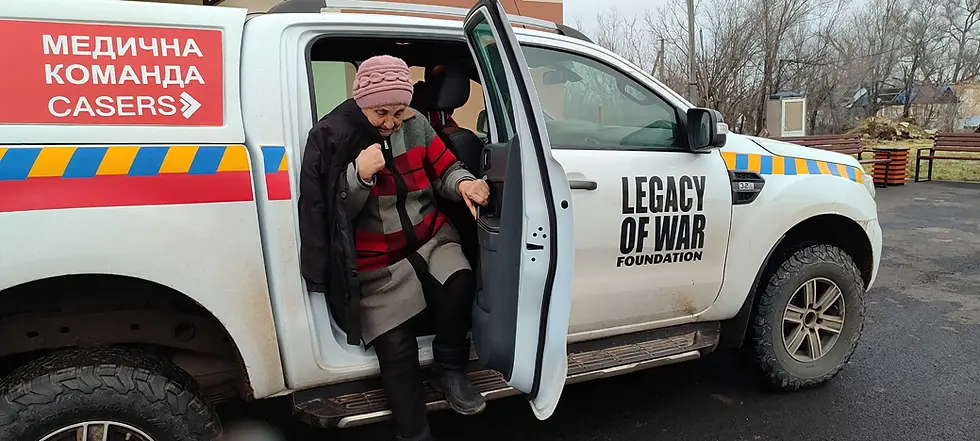
For patients with limited mobility, access to healthcare often meant bringing healthcare to their homes. Mobile medical teams carried out home visits for older people, persons with disabilities, and patients living with severe chronic illnesses who were unable to reach consultation sites on their own. When needed, the teams also helped transport patients, ensuring they could safely access essential medical services.


Project Results at a Glance
4 000
1 500+
2 000+
720+
Consultations delivered by mobile medical teams
People received care through mobile medical teams
Telemedicine consultations provided
Number of people who received telemedicine consultations
8
18
6
20
12
Communities reached
Settlements covered
Telemedicine centres in operation
Doctors involved
Medical specialties available
Patient Stories
Early Detection of Breast Disease
During a visit by the CASERS mobile medical team, a patient was advised to undergo additional diagnostic testing—a mammogram—after a breast specialist identified changes requiring further assessment. Following the examination, she was referred to an oncologist, which caused significant anxiety and uncertainty about her condition. At the telemedicine centre, the patient received a free consultation with a breast oncologist. After reviewing the examination results, the specialist confirmed that the detected lesions were benign and required only regular follow-up. This case illustrates how the combination of mobile medical teams and telemedicine enables early detection of breast diseases while providing patients with timely access to specialist expertise, reducing anxiety and supporting them during a difficult period.

The photographs illustrate the work of the mobile medical teams and telemedicine centres and do not necessarily depict the individuals whose stories are featured on this page.
About us in the media

With the support of
Telemedicine centres and Mobile Medical Units (MMUs) are implemented by NGO CASERS as part of the project "Resilient Care: Strengthening Inclusive Access to Healthcare Services in Southern Ukraine" in partnership with Médecins du Monde France and funded by the Crisis and Support Centre of the French Ministry for Europe and Foreign Affairs.

How to support us in providing medical help civilians in frontline and de-ocuppited areas?
Provide medical equipment
We're always looking for ways to provide more needed medical services. For this, we need:
— portable ultrasound;
— portable blood analyzer;
— fluorography machines;
— ophthalmologist's equipment;
— mobile dental clinic / portable dentist equipment, etc.
We're open to different opportunities to add new examination methods we can use on the spot during our missions.
Do you have other ideas?
Don't hesitate to contact us If you have other ideas on how to provide more quality services for people in de-occupied territories.
Please email us at


